
Shot Peening vs Shot Blasting: Different Jobs, Different Machines

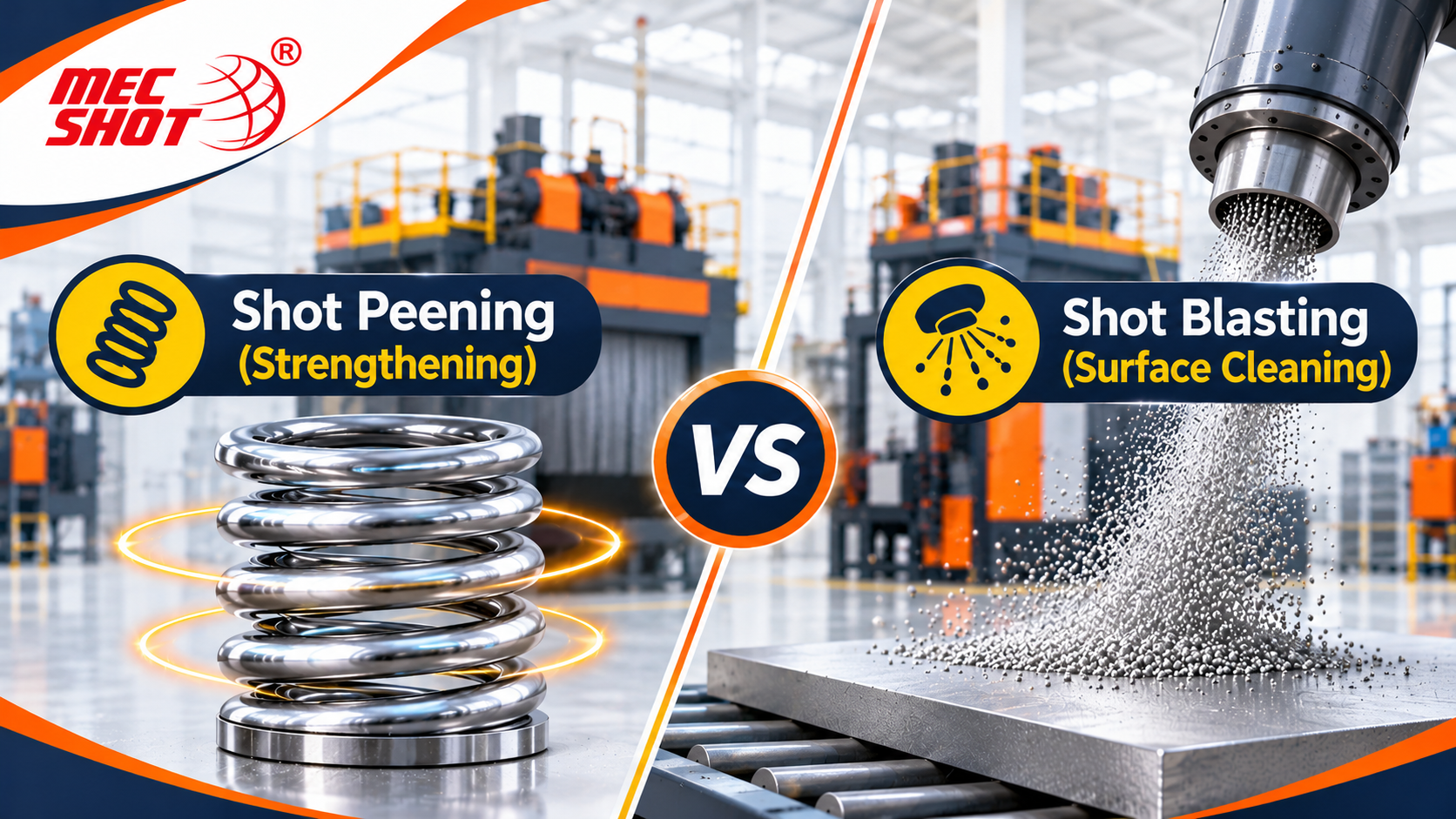
Two metal components can pass through similar-looking abrasive treatment equipment and leave with completely different engineering results. One may have a surface cleaned for painting, while the other may receive a treatment intended to improve its resistance to repeated mechanical stress.
This is the essential difference between shot peening and shot blasting. Both processes involve accelerated particles striking a metal surface, but they are developed around different manufacturing objectives. Shot blasting addresses surface preparation. Shot peening addresses the mechanical condition of the surface layer.
For manufacturers working with springs, gears, shafts, aircraft components and heavy-duty machinery, confusing these processes can lead to unsuitable equipment selection and incorrect treatment specifications. Understanding shot peening vs shot blasting requires looking beyond the machine's appearance and examining what the component must achieve during its service life.
Start with the Component's Engineering Requirement
The most reliable way to distinguish the two processes is to consider why the component is being treated.
Imagine a steel casting arriving from a foundry. Its surface contains residual sand, scale and other unwanted material. Before coating or further processing, the component needs to be cleaned. Shot blasting is suitable for evaluating this requirement.
Now consider a coil spring that repeatedly compresses and returns to its original position during operation. Its surface experiences cyclic stress, making fatigue performance an important design consideration. If its engineering specification requires beneficial compressive residual stresses, shot peening may be selected.
The processes therefore address different problems:
- Shot blasting: Removes unwanted surface material to achieve a required level of cleanliness or preparation.
- Shot peening: Uses controlled particle impact to modify the near-surface stress condition of a component.
This distinction also affects inspection. A clean appearance can help assess a blasting result, but it cannot prove that a component has received the specified peening treatment.
Shot Blasting: Preparing a Surface for the Next Operation
Shot blasting is used when a component needs a suitable surface condition before another manufacturing or finishing stage.
Abrasive particles are accelerated towards the workpiece using a rotating blast wheel or a compressed-air delivery system. Their impact helps remove rust, mill scale, foundry sand, old coatings and other unwanted material.
The process is commonly integrated into production lines where components must be cleaned before painting, coating, welding-related operations or further manufacturing.
What Determines the Blasting Arrangement?
The equipment configuration depends on how the component is presented to the abrasive stream.
A casting may require a handling arrangement that allows several surfaces to be exposed during treatment. Long fabricated sections may need a continuous conveyor arrangement. Smaller components may be processed in batches.
The selection depends on:
- Component dimensions and weight.
- Surface condition before treatment.
- Required cleanliness and surface profile.
- Component geometry and accessibility.
- Production quantity and cycle time.
- Abrasive recovery and dust extraction requirements.
The objective is to achieve the specified surface preparation consistently without using a more complex treatment than the application requires.
MEC SHOT provides industrial shot blasting machine solutions for different component-handling and surface-preparation applications.
Shot Peening: Treating the Surface for Mechanical Performance
Shot peening has a different purpose. It is used when the surface layer must be engineered to help a component withstand repeated loading.
During the process, selected spherical media strikes the component at controlled conditions. Each impact produces a small indentation and causes local plastic deformation. The surrounding material restricts this deformation, leaving compressive residual stresses near the surface.
When impacts overlap across the required treatment area, the component develops a compressively stressed surface layer.
Why Does This Matter?
Fatigue damage can develop when a component experiences repeated loading and unloading. Small cracks may initiate at surface defects, geometric transitions or areas exposed to high tensile stress.
Compressive residual stresses can reduce the effective tensile stress acting on the treated surface. Under suitable conditions, this can delay crack initiation and slow crack growth.
This is why shot peening is considered for components where fatigue performance is important.
However, the result is not automatic. The benefit depends on the material, component geometry, applied loading, surface condition and peening parameters. An unsuitable treatment can fail to deliver the intended result or affect the component's surface integrity.
Shot peening should therefore be treated as an engineered manufacturing operation, not simply as a more intensive form of blasting.
What Makes Peening Different from Ordinary Abrasive Impact?
The difference is not just the type of machine or the force of the abrasive stream. It is the level of control required over the treatment.
In ordinary blasting, the process is generally developed around cleaning performance, coverage, surface condition and production requirements.
In peening, the treatment must meet defined requirements for intensity, coverage and media condition. These variables influence the resulting surface stress condition.
Peening Intensity
Peening intensity is commonly evaluated using Almen strips. The strips respond to the impact stream by developing a measurable arc height. A saturation curve is used to establish intensity under defined test conditions.
The required intensity must come from the applicable component specification or an approved process-development procedure.
Increasing intensity without justification is not a reliable way to improve fatigue performance. Excessive treatment may create an unsuitable surface condition or introduce other problems.
Coverage
Coverage indicates how extensively the specified surface has received the peening treatment.
A component may have curved surfaces, recesses, edges and areas that are difficult to reach. If the media stream does not reach these locations as intended, the treatment may be incomplete.
Fixture design, nozzle position, component movement and exposure conditions must therefore be considered together.
Media Condition
Peening media must meet the required size, shape, hardness and cleanliness conditions. Broken or irregular particles can produce a different impact response from the specified media.
Media classification, separation and replacement are important because changes in media condition can affect process consistency.
CNC Shot Peening Machine: When Programmed Movement Matters
Some components are difficult to treat using a fixed nozzle arrangement. Their surfaces may include several angles, curved sections, recesses or areas that require different exposure paths.
A CNC shot peening machine uses programmed movement to coordinate the treatment path with the component geometry.
Depending on the machine configuration, the system may control nozzle movement, component rotation, indexing or multiple axes. This helps reproduce an approved treatment sequence across production cycles.
CNC control is particularly useful when:
- Components have complex or changing surface geometry.
- Specific areas require defined treatment paths.
- Component positioning must remain repeatable.
- Manual movement would make consistent coverage difficult.
- Production requires documented and repeatable operating sequences.
However, automation alone does not guarantee a successful peening result. The machine must still deliver the required intensity, media condition and coverage. The treatment must also be validated using the methods specified for the component.
MEC SHOT's current shot peening machine range includes specialised CNC systems for applications such as landing gears, turbine blades, titanium alloy beams, brake worm gears, rock drill bits and cylinder blocks.
Robotic Shot Blasting Machine and Robotic Peening: Similar Automation, Different Purpose
A robot can move a blasting nozzle around a component, but that does not automatically make the operation shot peening.
A robotic shot blasting machine uses programmed movement to direct an abrasive stream across a workpiece for cleaning or surface preparation. It can help reach complex external profiles and maintain a repeatable blasting path.
Robotic peening equipment uses controlled movement to deliver a specified peening treatment. Its purpose is to establish the required surface stress condition, not simply to clean the component.
Process consideration | Robotic shot blasting | Robotic shot peening |
Intended outcome | Clean or prepared surface | Controlled compressive residual stresses |
Main process objective | Remove unwanted material | Improve fatigue-related surface performance |
Important controls | Abrasive delivery, blast pattern and cleaning coverage | Intensity, coverage and media condition |
Typical equipment concern | Access to the required cleaning areas | Accurate treatment of specified peening areas |
Verification | Surface cleanliness and preparation requirements | Peening intensity, coverage and applicable specification |
The equipment should be selected according to the required treatment. A robotic blasting system is not a substitute for a properly engineered and validated peening system.
Which Industrial Components May Need Shot Peening?
Shot peening is relevant when the component's design and operating conditions make fatigue resistance an important consideration.
Coil springs: Repeated compression and release can expose springs to cyclic loading. Shot peening may be specified to improve fatigue performance.
Gears: Gear teeth experience repeated contact and bending loads. In suitable designs, peening can be used to address fatigue concerns in critical regions.
Shafts: Rotating shafts may experience alternating stresses, particularly around shoulders, fillets and other changes in geometry.
Landing gear components: Aircraft landing gear experiences demanding mechanical loads during operation. Selected parts may require controlled peening as part of their manufacturing specification.
Turbine components: Certain turbine parts operate under demanding mechanical and environmental conditions. Their surface-treatment requirements depend on the component material and design.
Rock drill bits and mining components: Selected heavy-duty components experience repeated mechanical stress and impact. Peening may be considered where the engineering specification supports its use.
These are application examples, not a universal recommendation. The component manufacturer or design authority must determine whether peening is appropriate.
Can Shot Blasting and Shot Peening Be Used on the Same Component?
Yes. A component may require both processes during manufacturing, but they serve separate purposes and must be controlled independently.
For example, a component may first undergo blasting to remove scale or other surface contamination. It may then receive shot peening if its specification requires a controlled compressive residual stress condition.
The sequence is not universal. It depends on the material, heat treatment, machining operations, coating requirements and approved manufacturing procedure.
One important consideration is that a subsequent operation can affect the peened surface. Aggressive material removal, grinding or other finishing work may reduce or remove part of the compressively stressed layer.
For this reason, the manufacturing sequence should be established before production begins. Cleaning requirements, peening parameters and any later finishing operation must be considered as part of the same process plan.
Selecting Equipment Based on the Required Treatment
Machine selection should begin with the component drawing and treatment specification rather than a general equipment category.
Before evaluating a machine, manufacturers should establish the following:
Component information: Dimensions, weight, material, heat-treatment condition and surface geometry.
Treatment objective: Required cleanliness and preparation for blasting, or specified peening intensity and coverage for fatigue-related treatment.
Media requirements: Type, size, hardness and condition of the media suitable for the application.
Production arrangement: Batch or continuous operation, component loading, fixture requirements and expected production volume.
Automation level: Manual, indexed, CNC-controlled or robotic movement according to component complexity and repeatability requirements.
Inspection method: The measurements and records needed to demonstrate that the process meets the approved specification.
A trial using representative components can help establish whether the proposed machine arrangement is suitable. It also gives manufacturers an opportunity to evaluate handling, access, process parameters and production practicality before finalising equipment.
MEC SHOT's Shot Peening Equipment and Application Development
MEC SHOT manufactures industrial surface-treatment equipment, including shot blasting and specialised shot peening systems.
Its current product portfolio includes air-operated and airless shot peening machines, along with CNC and robotic configurations for application-specific requirements.
The company's product range includes equipment for applications involving coil springs, landing gears, turbine blades, titanium alloy beams, brake worm gears and other engineered components.
Manufacturers evaluating different peening arrangements can review MEC SHOT's air-operated shot peening machines and airless shot peening machines.
The correct configuration depends on the component geometry, media delivery method, treatment area, handling arrangement and production requirements.
MEC SHOT's Technology Centre also describes customer sample processing and experiments used to evaluate process parameters, component performance and productivity. Such application-based evaluation is useful when the required treatment must be established for a particular component rather than selected from a general machine description.
Conclusion
Shot peening and shot blasting should be selected according to the problem a manufacturer needs to solve.
Shot blasting prepares a surface by removing unwanted material. Shot peening applies controlled particle impacts to introduce compressive residual stresses that can support fatigue resistance under suitable conditions.
The difference affects the entire manufacturing decision: media, machine configuration, automation, inspection and process approval.
For components that must withstand repeated mechanical loading, the treatment specification should guide equipment selection from the beginning. For components that need cleaning or preparation, the priority is achieving the required surface condition consistently.
The right machine is not simply the one with greater impact energy or more automation. It is the one designed around the component's actual engineering requirement.
Frequently Asked Questions
1. What is the main difference between shot peening vs shot blasting?
Shot blasting removes unwanted material such as rust, scale and coatings to prepare a surface. Shot peening uses controlled particle impacts to introduce compressive residual stresses near the surface and support fatigue performance.
2. Does shot peening improve fatigue life?
Shot peening can improve fatigue life by reducing the effective tensile stress at the treated surface. The benefit depends on material properties, component geometry, loading conditions and whether the process meets the required specification.
3. What is a CNC shot peening machine used for?
A CNC shot peening machine uses programmed movement to control the treatment path and component positioning. It is useful for complex components that require repeatable treatment across defined surface areas.
4. Is a robotic shot blasting machine the same as robotic shot peening equipment?
No. Robotic shot blasting is generally used for cleaning and surface preparation. Robotic shot peening is designed to deliver a controlled fatigue-related surface treatment. Their process objectives and verification requirements are different.
5. How is shot peening intensity measured?
Intensity is commonly evaluated using Almen strips and a saturation curve. The measured response helps establish the peening intensity under defined test conditions.
6. Can a component undergo both shot blasting and shot peening?
Yes, if its manufacturing specification requires both. Their sequence must be planned carefully because later operations, particularly material-removal processes, may affect the peened layer.
7. Which industries use shot peening?
Shot peening is used in applications across automotive, aerospace, power generation, railway, mining and other engineering sectors. It is considered for components where fatigue performance is an important design requirement.