
Blasting Media Guide: Steel Shot, Grit, Glass Bead and Aluminium Oxide

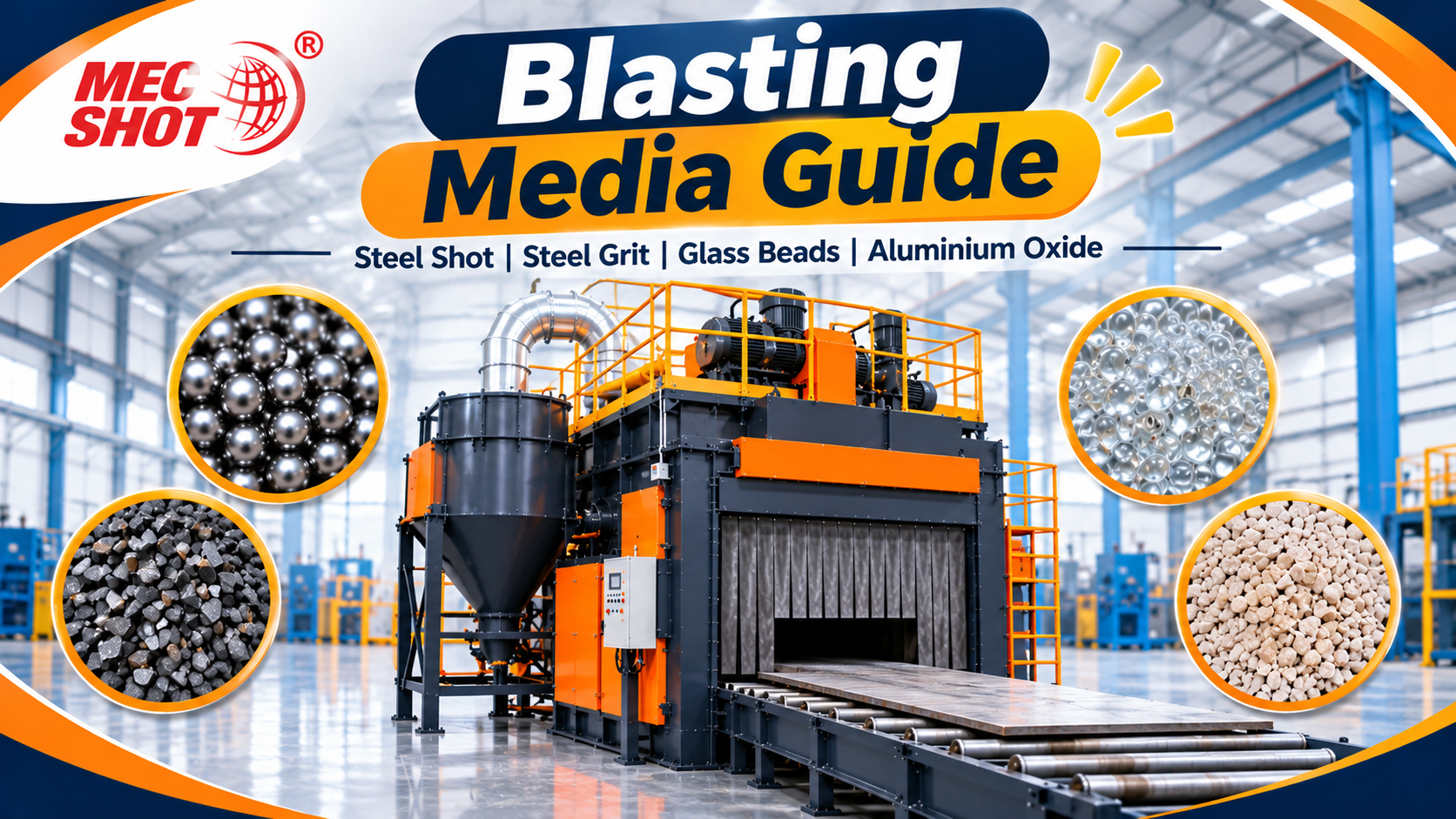
Selecting blasting media is an engineering decision that directly affects surface cleanliness, texture, component quality and operating cost. Two abrasives may remove the same coating but leave very different surface conditions. One may produce a relatively smooth finish, while another creates a sharper profile suitable for a protective coating.
This shot blasting abrasive media guide explains four widely used industrial abrasives: steel shot, steel grit, glass beads and aluminium oxide. It examines their working characteristics, suitable applications, limitations and selection criteria to help manufacturers choose media according to the actual treatment requirement.
Understanding Abrasive Blasting Media
Abrasive blasting media consists of particles accelerated against a workpiece to clean, finish or modify its surface. Depending on the equipment, particles are propelled through a centrifugal blast wheel or carried by compressed air through a blasting nozzle.
The result depends on more than the abrasive material itself. Five properties are particularly important:
- Shape: Spherical particles produce a different impact pattern from angular particles.
- Hardness: Influences the abrasive's ability to remove deposits and act on the substrate.
- Density: Affects the momentum carried by each particle.
- Particle size: Influences impact distribution, cleaning action and surface texture.
- Breakdown resistance: Determines how well particles retain their working characteristics during repeated use.
These properties explain why abrasive selection should begin with the required surface result rather than simply choosing the most aggressive material.
Steel Shot: For Impact-Based Cleaning and Peening
Steel shot consists of rounded metallic particles commonly used in industrial cleaning and surface treatment. Its spherical geometry creates repeated impact rather than the concentrated cutting action of angular abrasives.
Working Characteristics
When steel shot strikes a metal component, it transfers impact energy that helps dislodge rust, scale, foundry sand and other surface deposits. Under controlled conditions, repeated impacts can also create compressive residual stresses through shot peening.
However, cleaning and peening are different processes. A component cleaned with steel shot has not automatically received a qualified shot peening treatment. Peening requires controlled media properties, coverage and process verification.
Industrial Applications
Steel shot is commonly used for:
- Cleaning ferrous castings and forgings.
- Removing scale and surface deposits.
- Preparing metal components for subsequent manufacturing.
- Deburring and deflashing compatible parts.
- Shot peening when the process is properly specified.
For example, a foundry may use steel shot to remove residual sand and deposits from cast components before inspection or further processing.
Advantages and Limitations
Steel shot has relatively high density and can be reclaimed in suitable abrasive recovery systems. Its rounded shape makes it useful where repeated impact is preferred over aggressive cutting.
Its main limitation is ferrous composition. Where iron contamination is unacceptable, such as on certain non-ferrous components or controlled stainless-steel finishing applications, compatibility must be checked before use.
Steel Grit: For Aggressive Cleaning and Surface Profiling
Steel grit has an angular particle shape. Its edges create a cutting action that helps remove firmly attached deposits and produce a more pronounced surface texture.
Why Its Shape Matters
Angular particles concentrate impact at their edges. This makes steel grit suitable for removing heavy rust, mill scale and other stubborn surface layers.
It is also widely considered for coating preparation because the treatment can create a surface profile that supports mechanical adhesion. The required profile must, however, match the coating specification.
An excessively rough surface can create coating-coverage problems, particularly when the specified coating thickness is limited.
Typical Applications
Steel grit is used for:
- Heavy cleaning of ferrous castings.
- Surface preparation of fabricated steel.
- Cleaning steel rolls.
- Removing firmly attached scale and deposits.
- Producing a specified profile before protective coating.
Selection Considerations
Particle size, hardness and operating conditions influence the final texture. A larger abrasive particle does not automatically produce a better result. The correct grade depends on the existing surface condition, substrate and required profile.
Steel grit also requires attention to ferrous contamination. It should not be selected for a component simply because it removes deposits efficiently.
Glass Beads: For Controlled Cleaning and Finishing
Glass beads are spherical abrasive particles used where gentle cleaning or a consistent cosmetic finish is required. They are commonly considered for compatible stainless-steel, alloy-steel and other metal components.
Surface Effect
Unlike angular abrasives, glass beads generally produce a rounded impact. This can create a smooth satin or matte appearance without the same aggressive cutting action associated with steel grit or aluminium oxide.
Typical applications include:
- Removing light oxidation and surface deposits.
- Cleaning compatible metal components.
- Producing a uniform cosmetic finish.
- Deburring suitable parts.
- Treating stainless-steel and alloy-steel surfaces.
- Certain low-intensity peening applications when properly specified.
Why Choose Glass Beads?
Glass beads are useful when appearance and controlled surface treatment are more important than aggressive material removal. They can also be used in suitable dry or wet blasting systems.
A common mistake is choosing glass beads for a task that requires heavy scale removal or a defined aggressive profile. Their gentler action may not achieve the required result efficiently.
Reuse and Contamination
Glass beads can fracture during operation. Broken particles and fine material change the working mixture, which can affect finish consistency. Reclaimed media should therefore be checked for particle condition and contamination before reuse.
Aluminium Oxide: For Hard, Angular Abrasive Treatment
Aluminium oxide is a hard, angular mineral abrasive used for demanding surface preparation. Its cutting characteristics make it suitable for removing coatings, oxidation and deposits from compatible substrates.
Common Applications
Aluminium oxide is commonly considered for:
- Surface preparation before coating.
- Removal of oxidation and compatible coatings.
- Cleaning ferrous and non-ferrous components.
- Producing a textured surface.
- Applications where ferrous abrasive transfer is undesirable.
MEC SHOT lists aluminium oxide for dry and wet blasting applications and identifies its use on ferrous and non-ferrous components.
Key Characteristics
Its hardness and angular geometry provide an effective cutting action. Unlike steel shot and steel grit, aluminium oxide is not a steel-based abrasive, making it an option where ferrous media transfer must be avoided.
However, non-ferrous composition does not guarantee a contamination-free process. Equipment cleanliness, storage and media handling also matter.
Because aluminium oxide can be aggressive, the grade, particle size, pressure and exposure time should be matched to the workpiece. Thin or dimensionally sensitive components require particular care.
Steel Shot vs Steel Grit vs Glass Beads vs Aluminium Oxide
Parameter | Steel Shot | Steel Grit | Glass Beads | Aluminium Oxide |
Composition | Steel | Steel | Glass | Mineral |
Shape | Spherical | Angular | Spherical | Angular |
Main action | Impact | Cutting | Gentle impact | Cutting |
Typical result | Cleaned surface | Textured surface | Satin or matte finish | Textured surface |
Common purpose | Cleaning and peening | Heavy cleaning and profiling | Controlled finishing | Surface preparation |
Main concern | Ferrous transfer | Ferrous transfer and profile control | Particle breakage | Aggressive treatment |
This comparison is a general selection reference. Actual results depend on abrasive grade, particle condition, equipment settings and substrate properties.
How to Select the Correct Abrasive Media
A reliable selection process begins with the component and the required result.
Identify the Substrate
Carbon steel, stainless steel, aluminium, brass and other alloys respond differently to abrasive impact. Check whether ferrous transfer is acceptable and whether the material can tolerate the proposed treatment.
Define the Surface Requirement
Determine whether the job requires general cleaning, heavy deposit removal, a specified surface profile, cosmetic finishing or controlled peening. These are different objectives and may require different abrasives.
Check Particle Size and Hardness
Particle size influences impact distribution and surface texture. Hardness affects cutting performance. Select both according to the substrate and acceptance criteria rather than assuming that a coarser or harder abrasive is always better.
Consider Component Geometry
Thin sections, internal passages, recesses and complex shapes may respond differently from flat or accessible surfaces. The abrasive must reach the required areas without causing unacceptable damage.
Validate the Result
For critical components, test the proposed media on representative samples. Inspect cleanliness, surface profile, appearance, contamination and dimensional condition before adopting the process for production.
Abrasive Condition, Recovery and Quality Control
Abrasive performance changes during repeated use. Particles can fracture, wear down or collect contaminants removed from the workpiece.
In a recirculating system, the working mixture should be maintained through suitable collection, separation and inspection.
Important checks include:
- Particle distribution: Excessive breakdown changes the abrasive's working behaviour.
- Dust and fines: Fine particles can affect process consistency and increase dust loading.
- Foreign material: Oil, coating residues and unwanted metallic particles can contaminate the surface.
- Separation efficiency: The recovery system should remove unsuitable particles according to its design.
- Surface inspection: The treated component must meet the specified cleanliness and profile requirements.
Media reuse should not be judged only by the number of cycles. Its condition and ability to deliver a consistent result are more important.
Machine Compatibility and Workplace Safety
The abrasive must also suit the delivery system. Wheel-driven machines accelerate media through a rotating blast wheel, while pneumatic machines carry abrasive through a compressed-air nozzle. Particle characteristics and machine-manufacturer recommendations should be checked before using a particular media in either system.
MEC SHOT manufactures Airless / Wheel Shot Blasting Machines and Air Operated Shot Blasting Machines for different industrial applications. The appropriate equipment depends on the component, process and abrasive compatibility.
Safety is equally important. Blasting can generate airborne abrasive dust and particles from removed coatings or substrate deposits. Silica-containing blasting materials are a particular concern because respirable crystalline silica can cause silicosis. Ordinary silica sand should not be treated as a safe default abrasive.
A suitable operation needs appropriate enclosure, ventilation, dust extraction, personal protective equipment and safe disposal arrangements. MEC SHOT also lists Industrial Dust Collectors for industrial dust-control applications.
MEC SHOT Abrasive Media Range
MEC SHOT's current abrasive media range includes Steel Shots, Steel Grit, Aluminum Oxide and Glass Beads. Its live product category also lists Chilled Iron Grit, Chilled Iron Shots, DF Grit, Nylon Shots, Plastic Grit Acrylic, Plastic Grit Urea and Steel Cut Wire.
This wider selection is relevant because not every component can be treated effectively with the same abrasive. Substrate compatibility, surface appearance, contamination restrictions and treatment intensity may call for alternative media.
Explore the MEC SHOT Abrasive Media range to review the listed options. For a production application, the abrasive should be evaluated alongside the equipment and required surface condition. A representative sample trial can help establish whether the proposed combination is suitable.
Conclusion
Steel shot, steel grit, glass beads and aluminium oxide produce different surface effects because their geometry and material properties are different. Steel shot is widely used for impact-based cleaning and controlled peening; steel grit supports aggressive cleaning and profiling; glass beads are suited to gentler finishing; and aluminium oxide provides a hard, angular cutting action.
The right abrasive is not necessarily the hardest, largest or most aggressive. It is the one that meets the component's surface requirement without unacceptable contamination, damage or operating cost.
Frequently Asked Questions
1. What is the best abrasive media for shot blasting?
There is no universal best abrasive. Steel shot, steel grit, glass beads and aluminium oxide serve different purposes. Selection depends on substrate, surface condition and required finish.
2. What is the difference between steel shot and steel grit?
Steel shot has a spherical shape and produces an impact-based cleaning action. Steel grit is angular and creates a stronger cutting action, making it suitable for heavy cleaning and surface profiling.
3. Is aluminium oxide suitable for stainless steel?
It can be suitable when the required finish and process conditions support its use. Equipment cleanliness and media handling must also be controlled to prevent unwanted contamination.
4. Can glass beads remove heavy rust?
Glass beads are generally selected for gentler cleaning and finishing. Heavy rust or firmly attached scale may require a more aggressive abrasive, depending on the substrate and required result.
5. Can steel shot be reused?
Yes. Steel shot can be reclaimed in suitable recovery systems. Its reuse depends on particle breakdown, contamination, separation efficiency and the condition of the working abrasive mixture.
6. Which abrasive is suitable for surface profiling before painting?
Angular abrasives such as steel grit and aluminium oxide are commonly used for profiling. The required profile should be established by the coating specification and verified using an appropriate measurement method.
7. How do I choose the right abrasive blasting media?
Identify the substrate, existing contamination, required finish, dimensional restrictions and machine compatibility. For critical applications, test the proposed abrasive on representative components before production.