
How to Choose a Shot Blasting Machine: 7 Questions to Answer Before You Buy

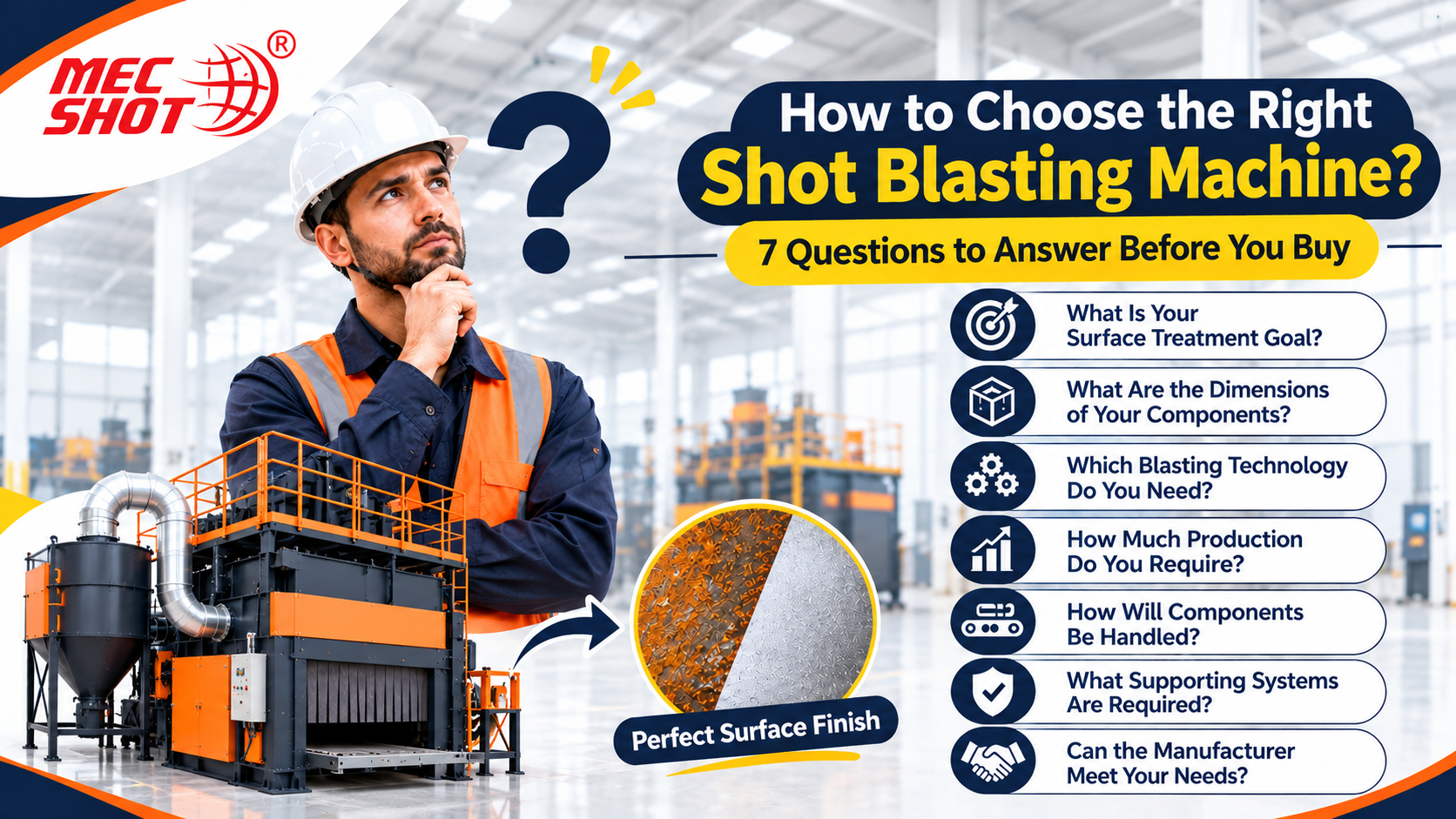
How to choose shot blasting machine is an important decision when investing in industrial surface preparation equipment. The right machine must match the components being processed, the required surface condition, and the factory's production needs. Choosing equipment based only on price or advertised capacity can lead to the wrong selection.
1. What Is the Actual Surface Treatment Requirement?
Start by defining the result you expect from blasting.
Is the purpose to remove rust, mill scale, foundry sand, or old coatings? Do components need surface preparation before painting, or is a particular surface profile required?
Different applications need different abrasive types, exposure conditions, and machine arrangements. Define the required cleanliness and surface profile using the relevant project specification before discussing equipment.
2. What Are the Dimensions and Weight of Your Components?
Workpiece dimensions determine the available machine options.
Small, suitable components may be processed in a tumblast machine.
Heavy or irregular components may require hanger-type handling.
Long steel sections may need a roller conveyor or tunnel machine.
Large fabricated structures may require a blast room.
Also consider component spacing, loading clearance, and accessibility of surfaces during blasting. Maximum workpiece dimensions alone are not enough to finalise a machine.
3. Which Blasting Technology Fits Your Production?
Industrial blasting equipment generally uses two abrasive-propulsion methods.
Airless or wheel blasting: A rotating wheel accelerates abrasive towards the component. It is commonly used in automated production equipment.
Air-operated blasting: Compressed air-operated category propels abrasive through a nozzle. It is suitable for portable equipment, blasting cabinets, and other applications requiring flexible operation.
MEC SHOT manufactures both air-operated and airless blasting equipment. The suitable option depends on the workpiece, production process, and required surface treatment.
4. How Many Components Must Be Processed Per Shift?
Production demand helps determine whether a batch or continuous machine is appropriate.
For example, a foundry processing batches of suitable castings may evaluate a tumblast machine. A steel fabrication unit handling long sections may need a roller conveyor system.
When discussing capacity, ask the manufacturer to consider actual component loading, blasting cycle, unloading, and changeover time. A theoretical machine capacity may not represent achievable production output.
5. How Will Components Be Handled Inside the Machine?
Component handling affects blasting coverage and operating efficiency.
MEC SHOT's published range includes:
Tumblast machines: For suitable components processed in batches.
Hanger-type machines: For individually suspended workpieces.
Swing table machines: For components requiring table-based support.
Roller conveyor machines: For suitable long steel products.
Special-purpose machines: For specific industrial handling requirements.
The correct arrangement should provide suitable abrasive access while keeping components stable throughout the process.
6. What Supporting Systems Are Included?
The blasting chamber is only one part of an industrial installation. Check the complete equipment arrangement before comparing quotations.
Important systems include:
Abrasive recovery and circulation
Abrasive separation
Dust collection and filtration
Component conveying and handling
Electrical controls and safety provisions
Access for inspection and maintenance
For example, MEC SHOT's published hanger-machine configuration includes a bucket elevator, screw conveyor, rotary screen separator, and dust collector.
The exact supporting equipment depends on the proposed machine design.
7. Can the Manufacturer Meet Your Specific Application Requirements?
Standard equipment may not suit every component or production process. Some applications need customised chamber dimensions, blast wheel arrangements, fixtures, or material-handling systems.
Before requesting a quotation, prepare:
Component drawings or photographs
Material and component weight
Minimum and maximum dimensions
Production quantity
Required surface finish
Available factory space
Loading and unloading method
Providing these details allows the manufacturer to assess the application instead of recommending equipment based on assumptions.
Which Shot Blasting Machine Should You Consider?
Application | Machine to Evaluate |
Suitable small components in batches | Tumblast |
Heavy or irregular workpieces | Hanger type |
Components requiring table support | Swing table |
Long steel sections and plates | Roller conveyor / tunnel |
Large structures | Blast room |
Flexible manual blasting | Air-operated equipment |
These are preliminary recommendations. Final machine selection requires an application-specific assessment.
Choose Your Shot Blasting Machine with MEC SHOT
MEC SHOT Blasting Equipments Pvt. Ltd. manufactures industrial surface preparation equipment, including air-operated and airless shot blasting machines, shot peening systems, blast rooms, and dust collectors.
Its equipment range serves applications across foundries, fabrication, automotive, engineering, and other manufacturing industries.
If you are evaluating a shot blasting machine for sale, discuss your component details and production requirements with MEC SHOT before finalising the configuration.
Frequently Asked Questions
1. How do I choose a shot blasting machine?
Consider the surface treatment objective, component dimensions, material, production quantity, handling method, and required finish. These factors help identify the appropriate machine configuration.
2. Which blasting machine is suitable for heavy components?
Hanger-type machines are commonly considered for heavy workpieces that require individual suspension. Large structures may be better suited to a blast room.
3. What is the difference between airless and air-operated blasting?
Airless machines use centrifugal blast wheels to propel abrasive, while air-operated machines use compressed air and a blasting nozzle.
4. Can a shot blasting machine be customised?
Yes. MEC SHOT offers customised blasting solutions based on component dimensions, production requirements, and application specifications.
5. What information should I provide when requesting a machine quotation?
Provide component drawings, material, dimensions, weight, production quantity, required surface condition, and factory installation details.
6. Why is abrasive recovery important?
Abrasive recovery collects reusable media and returns it to the blasting system after separation. It supports efficient media management and continuous operation in suitable machine configurations.