
Sa 2.5 vs Sa 3 and SSPC Standards: What Surface Cleanliness Grade Do You Need?

Selecting the correct surface cleanliness grade is an important part of industrial coating preparation. Steel that looks clean after abrasive blasting may still fail inspection if visible rust, mill scale or previous coating remains beyond the permitted limits. Choosing the wrong grade can also increase blasting time and operating costs without improving the performance of the final coating system.
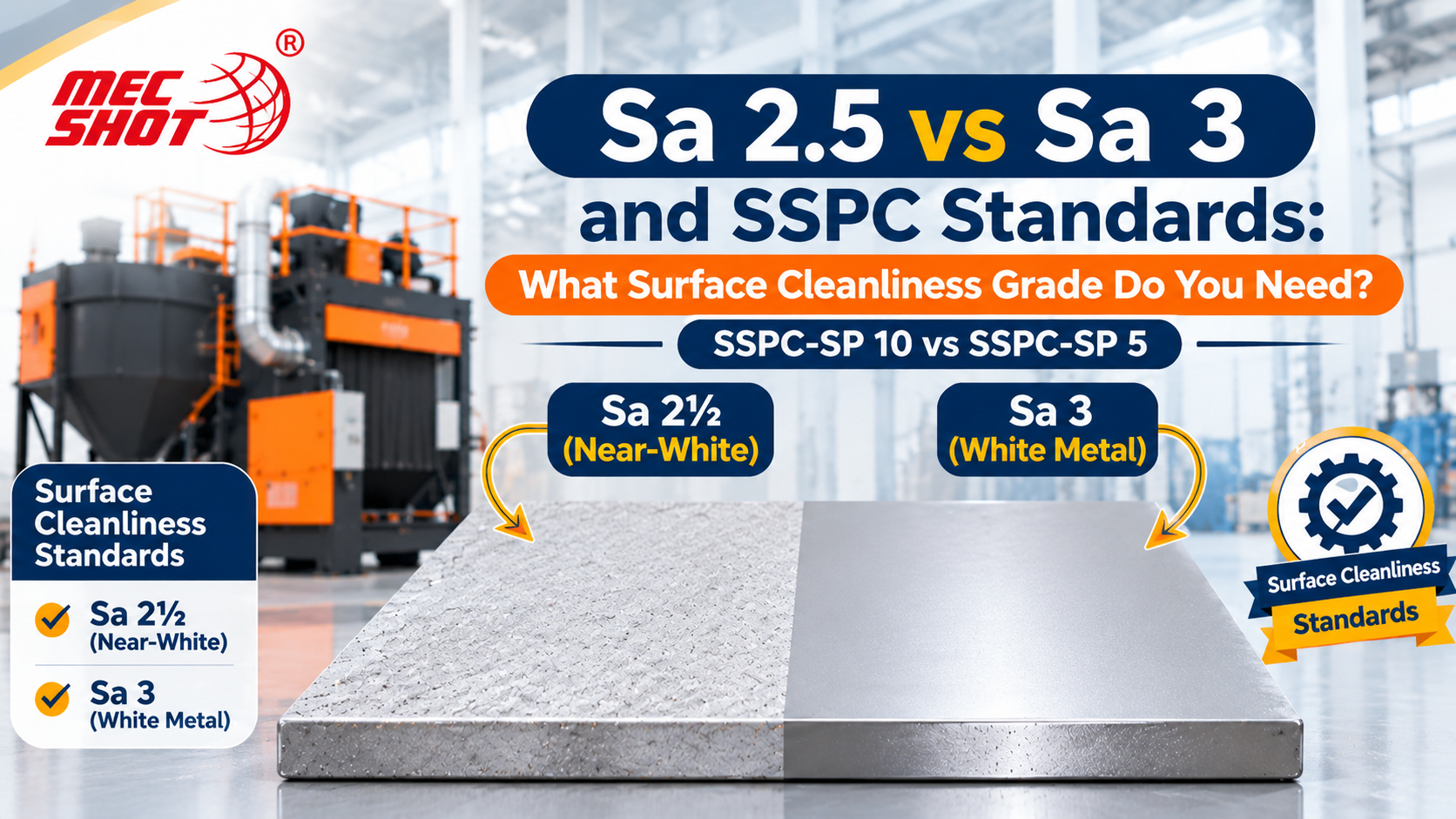
SA 2.5 shot blasting equipment is commonly specified when steel requires very thorough abrasive cleaning before painting. Sa 3 demands a stricter visual condition, with a uniformly clean metallic appearance. In the SSPC system, near-white metal cleaning is covered by SSPC-SP 10, while white metal cleaning is covered by SSPC-SP 5.
Although these grades are commonly compared, their written acceptance criteria are not identical. Understanding the difference helps manufacturers, coating contractors and inspection teams specify a surface condition that meets the actual project requirement.
What Does SA 2.5 Shot Blasting Mean?
Sa 2½ is a preparation grade defined in ISO 8501-1:2007 as very thorough blast-cleaning. The standard requires visible oil, grease and dirt to be absent. Mill scale, rust, paint coatings and other foreign matter must also be removed, except for slight remaining traces in the form of spots or stripes.
In practical terms, the steel must be thoroughly cleaned, but a small amount of permitted staining may remain. The surface is assessed visually without magnification using the written requirements and representative photographs in the standard.
Understanding Shot Blasting SA 2.5 Meaning in Practice
Consider a steel plate that arrives at a blasting facility with rust, mill scale and traces of an old coating. After preparation to Sa 2½, these contaminants should be removed to the required visual condition. Only slight permitted stains may remain.
Achieving this grade requires attention to more than the machine's operating time. The result can be affected by:
Initial rust and mill scale condition.
Abrasive type, size, hardness and condition.
Abrasive flow and impact energy.
Component geometry and accessibility.
Exposure time and coverage across the surface.
Inspection lighting and the applicable visual reference.
Welds, edges, corners and corrosion pits deserve particular attention because contamination can remain in areas that are difficult to reach. A component should not be accepted simply because its largest flat surfaces appear clean.
What Is Sa 3 White Metal Blasting?
Sa 3 is described in ISO 8501-1 as blast-cleaning to visually clean steel. The prepared surface must be free from visible oil, grease, dirt, mill scale, rust, paint coatings and other foreign matter. It should have a uniform metallic colour when viewed without magnification.
The main difference from Sa 2½ is the acceptance of remaining stains. Sa 2½ permits slight traces in the form of spots or stripes, whereas Sa 3 requires a visually clean metallic surface without those remaining traces.
When Is SA 3 Required?
Sa 3 is appropriate when the project specification explicitly requires white metal cleanliness. It may be selected for demanding coating projects where the specified preparation standard does not permit visible staining.
However, the strictest grade is not automatically the right choice for every job. A coating system designed around Sa 2½ does not necessarily benefit from additional cleaning to Sa 3. The required grade should be established by the coating specification, service environment and inspection plan.
Sa 2.5 vs Sa 3: Main Technical Differences
Inspection point | Sa 2½ | Sa 3 |
ISO description | Very thorough blast-cleaning | Blast-cleaning to visually clean steel |
Visible rust | Slight permitted traces may remain | No visible traces |
Mill scale | Slight permitted traces may remain | No visible traces |
Previous coating | Slight permitted traces may remain | No visible traces |
Appearance | Thoroughly cleaned steel with permitted staining | Uniform metallic colour |
Relative requirement | Very high | More stringent |
The difference is a visual acceptance requirement, not a fixed blasting duration or machine setting. A longer blasting cycle does not automatically establish compliance. The finished surface must be checked against the specified grade.
Understanding SSPC-SP 10 and SSPC-SP 5
SSPC surface preparation standards are maintained within the AMPP standards framework. They provide written requirements for different levels of abrasive blast-cleaning.
SSPC-SP 10: Near-White Metal Blast Cleaning
SSPC-SP 10 defines near-white metal blast cleaning. Visible oil, grease, dust, dirt, mill scale, rust, coatings, oxides, corrosion products and other foreign matter must be removed.
The standard permits limited random staining, such as light shadows, slight streaks or minor discolouration. This staining must not exceed 5% of each unit area.
The 5% allowance does not mean that any remaining rust or paint is acceptable on 5% of the surface. Only the specified forms of light staining are permitted.
SSPC-SP 5: White Metal Blast Cleaning
SSPC-SP 5 defines white metal blast cleaning. It requires the removal of visible oil, grease, dust, dirt, mill scale, rust, coatings, oxides, corrosion products and other foreign matter.
Unlike SP 10, this grade does not permit the defined staining allowance. It establishes a more stringent visual cleanliness requirement.
How Do ISO and SSPC Grades Compare?
The following pairings are commonly used as general industry references:
ISO 8501-1 grade | Common SSPC reference | Description |
Sa 2½ | SSPC-SP 10 / NACE No. 2 | Near-white metal cleaning |
Sa 3 | SSPC-SP 5 / NACE No. 1 | White metal cleaning |
These are commonly corresponding grades, not exact interchangeable definitions. For example, SSPC-SP 10 uses a specific 5% staining limit, while ISO Sa 2½ describes slight stains in the form of spots or stripes.
If a project specifies an SSPC standard, its own acceptance criteria should govern inspection. If both ISO and SSPC standards are named, the project documentation should clarify how compliance with each will be assessed.
How to Choose the Correct Surface Cleanliness Grade
The right grade should be selected before blasting begins. The decision should be based on the coating system and the conditions the finished component will face.
1. Review the Coating Manufacturer's Requirements
Start with the coating manufacturer's technical data sheet. Check its requirements for surface cleanliness, profile, soluble salts, dust and application conditions. Different coating systems may require different preparation conditions.
2. Consider the Operating Environment
A component exposed to moisture, chemicals, marine conditions or industrial pollution may require a different protective coating system from one used indoors in a controlled environment.
The exposure conditions help determine the coating system. The coating specification then establishes the required surface preparation grade.
3. Confirm the Contract Standard
The project specification should identify the exact standard and applicable edition. Avoid relying on informal terms such as "clean steel" or "white finish" without a recognised grade.
The inspection team should also know which visual references and acceptance limits apply.
4. Balance Process Cost with Compliance
A stricter cleanliness grade can require additional blasting effort, particularly on heavily corroded or irregular components. This can increase abrasive consumption, energy use and production time.
However, production targets cannot justify accepting a surface that fails the specified grade. The objective is to achieve the required condition consistently, without unnecessary over-processing.
Surface Cleanliness Is Not the Same as Surface Profile
A surface can meet Sa 3 visually and still have an unsuitable profile for the selected coating. Cleanliness and roughness are separate characteristics.
Surface cleanliness describes the removal of visible rust, mill scale, old coatings and other contamination.
Surface profile describes the texture created by abrasive impact. Its depth and characteristics influence how the coating interacts with the prepared steel.
Abrasive size, shape, hardness, impact energy and the original steel condition can affect the resulting profile. The required profile should be specified and measured separately using an appropriate method, such as the relevant procedures in ISO 8503 or applicable ASTM standards.
What About Dust and Soluble Salts?
Visual inspection cannot confirm that a blasted surface is free from every harmful contaminant.
Soluble salts may remain in corrosion pits even after visible rust has been removed. Excessive contamination can contribute to coating defects, depending on the coating system and exposure conditions.
Blasting can also leave dust and loose abrasive particles on the surface, particularly around welds, corners and recessed areas.
Where required by the project, the inspection plan should include:
Soluble salt testing using an agreed method.
Surface dust assessment.
Removal of loose abrasive and debris.
Checks for moisture exposure and flash rust before coating.
These checks complement the visual cleanliness grade; they do not replace it.
How Shot Blasting Equipment Supports Surface Preparation
The selected blasting equipment must suit the component's size, shape, material and production requirements. A machine does not automatically guarantee Sa 2½ or Sa 3. The actual result depends on abrasive condition, process settings, coverage, component movement and inspection.
For components suited to automated wheel blasting, MEC SHOT's Airless / Wheel Shot Blasting Machines include configurations such as tunnel, tumblast, hanger and swing table machines.
The High Speed Airless Blast Wheel is relevant to the abrasive delivery process. Its technical description covers the feed spout, impeller, control cage and blades, which influence abrasive distribution and the blasting pattern.
For larger structures requiring an enclosed work area, MEC SHOT Mechanical Recovery Blast Room Systems provide an option for blasting and abrasive recovery.
Equipment selection should be supported by a process assessment using representative components. The objective is to establish suitable operating parameters and verify the resulting surface against the required cleanliness grade.
Common Mistakes When Specifying Sa 2.5 and Sa 3
Avoid these frequent specification and inspection errors:
Treating Sa 2½ and SSPC-SP 10 as perfectly identical.
Applying the SSPC 5% staining allowance directly to ISO Sa 2½.
Assuming that Sa 3 automatically guarantees better coating adhesion.
Ignoring surface profile and non-visible contamination.
Inspecting only accessible flat areas while overlooking welds and recesses.
Selecting a stricter grade without checking the coating specification.
Failing to identify the applicable standard edition in the contract.
A clear specification reduces disagreement between the blasting contractor, coating applicator and inspection team.
Conclusion: Which Surface Cleanliness Grade Do You Need?
Sa 2½ and Sa 3 define different visual cleanliness requirements. Sa 2½ allows slight permitted stains after very thorough blast-cleaning, while Sa 3 requires a visually clean steel surface with a uniform metallic appearance.
In the SSPC system, SP 10 is the near-white metal reference and SP 5 is the white metal reference. Their general comparison with ISO grades is useful, but their written acceptance criteria should not be treated as identical.
The correct grade is the one required by the coating system, service environment and project specification. Reliable results also depend on suitable blasting equipment, consistent process control and separate checks for surface profile, dust and soluble salts where required.
Frequently Asked Questions
1. What is SA 2.5 shot blasting?
Sa 2½ is a very thorough abrasive blast-cleaning grade under ISO 8501-1. It requires the removal of visible oil, grease, dirt, rust, mill scale and previous coatings, allowing only slight remaining traces in the form of spots or stripes.
2. What is the difference between Sa 2.5 and Sa 3?
Sa 2½ permits slight visible stains that meet its acceptance description. Sa 3 requires visually clean steel with a uniform metallic appearance and no visible traces of the specified contaminants.
3. Is Sa 2.5 equivalent to SSPC-SP 10?
They are commonly compared as near-white metal cleaning grades, but their written criteria differ. SSPC-SP 10 specifies a maximum 5% allowance for defined random staining in each unit area. ISO Sa 2½ uses its own descriptive visual criteria.
4. What does SSPC-SP5 shot blasting mean?
SSPC-SP 5 is the white metal blast-cleaning standard. It requires visible rust, mill scale, coatings and other specified contaminants to be removed, without the staining allowance permitted under SP 10.
5. Does Sa 3 guarantee better paint adhesion than Sa 2.5?
No. Sa 3 has a stricter visual cleanliness requirement, but coating adhesion also depends on surface profile, soluble salts, dust, coating compatibility and application conditions. The coating specification should determine the required grade.