
How a Shot Blasting Machine Works: From Blast Wheel to Finished Surface

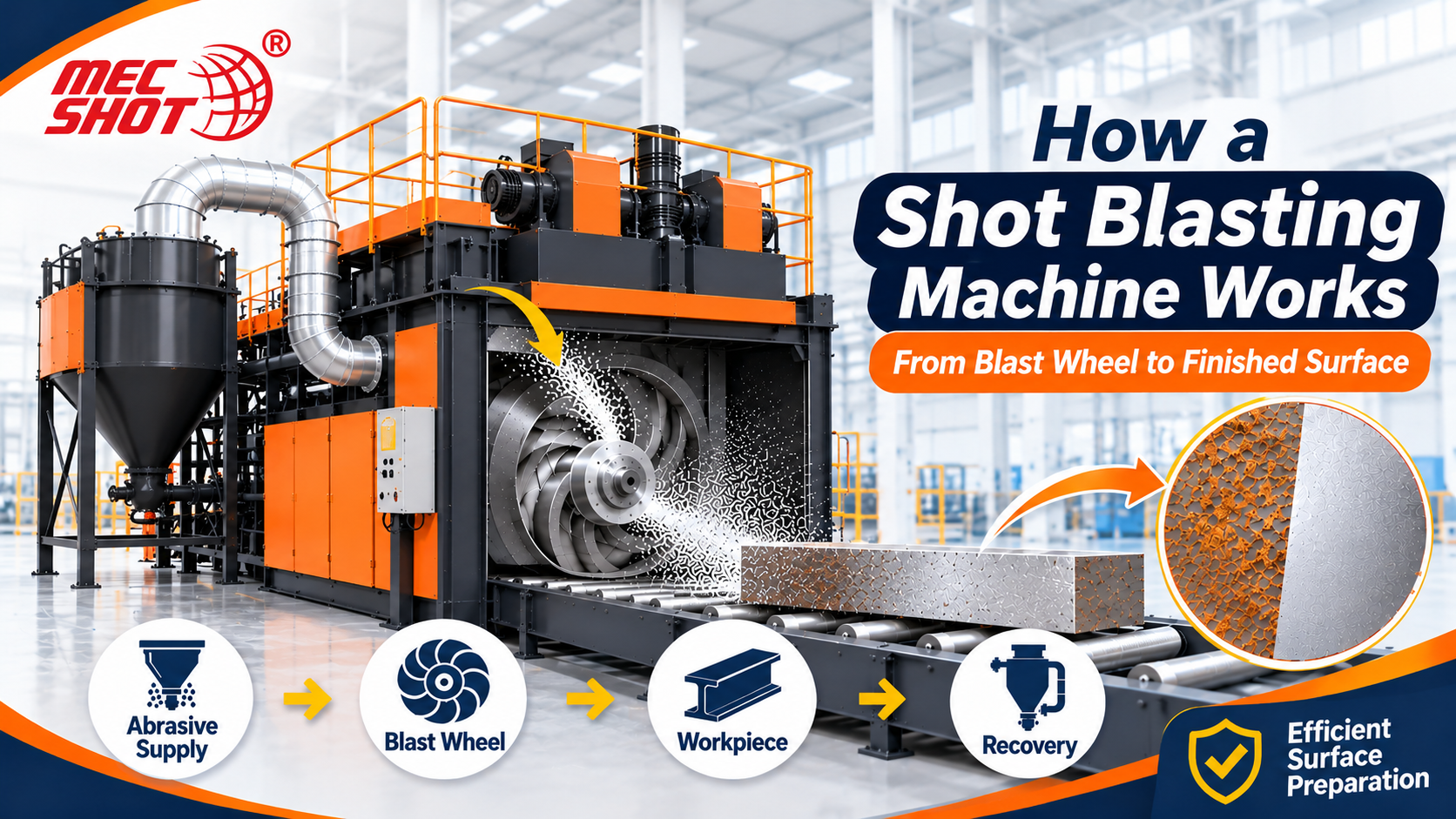
A finished metal surface is the result of several mechanical operations taking place in a controlled sequence. Abrasive must reach the blast wheel at a suitable rate, leave the wheel in the intended direction, contact the required areas of the component, and then be recovered or separated from unwanted material.
The shot blasting machine working principle is based on transferring rotational energy from a motor-driven wheel to abrasive particles. These particles strike the workpiece with sufficient energy to remove unwanted surface deposits. The quality of the result depends on how accurately the machine controls this sequence.
To understand the process properly, it helps to follow the movement of energy, abrasive, and the workpiece through an industrial blasting cycle.
The Process Starts with a Controlled Abrasive Supply
Before the blast wheel can operate effectively, it needs a consistent supply of suitable abrasive.
The media is stored in a hopper or supply arrangement and delivered towards the wheel through a feed mechanism. The amount entering the wheel must be appropriate for the machine's operating conditions and the component being treated.
Abrasive supply is an important process variable because the wheel must handle the incoming media without disrupting its projection pattern.
An unstable feed can lead to inconsistent abrasive delivery. An unsuitable feed rate can also affect the balance between media consumption and the required surface treatment.
For this reason, abrasive flow should be considered alongside wheel operation rather than treated as an independent setting.
How Rotational Energy Becomes Abrasive Impact
In a wheel blasting machine, an electric motor drives the blast wheel. The rotating assembly transfers energy to the abrasive and sends it towards the workpiece.
The process involves three main actions:
The incoming media is distributed inside the wheel.
A controlled arrangement guides it towards the rotating blades.
The blades accelerate the particles outwards through centrifugal action.
This mechanical projection method is known as centrifugal blasting.
Unlike a compressed-air nozzle, the wheel does not depend on a high-pressure air stream to propel the main abrasive flow. Its rotating assembly provides the force required for projection.
The actual impact delivered to the component depends on abrasive characteristics, wheel operating conditions, and the distance and direction between the wheel outlet and the workpiece.
What Happens Between the Wheel and the Workpiece?
After leaving the wheel, abrasive travels towards the component along a defined trajectory.
The relationship between the wheel outlet and the workpiece is important. A wheel may operate correctly, but poor positioning can prevent the abrasive from reaching the intended surface area.
Three engineering considerations influence this stage:
Projection direction: The abrasive stream must be aligned with the area requiring treatment.
Impact distance: The distance between the wheel outlet and the component influences how the abrasive stream reaches the surface.
Surface accessibility: Component geometry can create areas that are difficult to expose directly to the abrasive stream.
These considerations become especially important when treating components with recesses, edges, internal features, or changing cross-sections.
The wheel arrangement should therefore be developed around the actual component geometry instead of assuming that one projection position will suit every workpiece.
How Workpiece Movement Influences the Finished Result
The blast wheel supplies the abrasive impact, but the component's movement determines how different areas are exposed.
Consider a long steel section passing through an industrial blasting chamber. Its movement through the machine must be coordinated with the position of the blast wheels. If the conveying arrangement moves too quickly or the wheel coverage is unsuitable, some areas may receive insufficient treatment.
A different arrangement is used for suspended components. The hanger carries the workpiece through the chamber, while the wheel positions are selected according to the required treatment coverage.
The machine's control system coordinates the operating sequence. Depending on the design, this can involve conveyor movement, hanger operation, wheel activation, and timed loading or unloading.
How Does Abrasive Impact Change the Surface?
When abrasive particles strike a metal component, their impact helps dislodge rust, mill scale, foundry residue, and other unwanted material.
However, the surface result is not determined by impact alone. It depends on the relationship between abrasive properties and the treatment conditions.
For example:
Rounded steel shot generally produces a different impact pattern from angular steel grit.
Larger and smaller abrasive particles interact with the surface differently.
Changes in wheel operation can affect the energy delivered by the media.
Different exposure conditions can produce different levels of surface treatment.
The required result should be defined before the process is finalised. Where components are prepared for coating, the surface cleanliness and profile should be checked against the applicable project specification.
A clean-looking component should not automatically be considered ready for coating without the required inspection.
What Happens to the Abrasive After It Strikes the Component?
Abrasive used in an industrial installation does not necessarily become waste after one impact. Suitable media can be collected, cleaned, and returned to the blasting circuit.
The recovery sequence depends on the machine design, but a mechanical system may use the following arrangement:
Collection system: Used abrasive and removed material are gathered from the lower section of the equipment.
Conveying system: A screw conveyor or another suitable mechanism moves the mixture towards the lifting arrangement.
Bucket elevator: The collected material is raised to the separation equipment.
Abrasive separator: Dust, broken particles, and unwanted contaminants are removed from the reusable media.
Storage and supply: Suitable abrasive returns to the storage arrangement for another operating cycle.
This return circuit is important because abrasive quality influences the consistency of the process. If excessive dust or broken particles remain in circulation, the media condition can become unsuitable for the intended operation.
MEC SHOT's published hanger-machine configuration includes components such as a bucket elevator, screw conveyor, and rotary screen separator as part of its media recovery arrangement.
How Dust Extraction Completes the Operating Cycle
Abrasive impact produces fine particles from the media and the material removed from the component. These particles must be separated from reusable abrasive and managed through a suitable extraction system.
A dust collector draws contaminated air from the machine or connected collection points. The filtration arrangement captures particulate matter, which is subsequently discharged into a collection unit.
The extraction system and abrasive separator perform related but different functions:
The separator helps clean the abrasive returning to the blasting circuit.
The dust collector filters dust-laden air from the equipment.
Both systems contribute to maintaining the operating environment and the condition of the circulating media.
Their capacity and arrangement should be suitable for the machine design and the dust generated by the application.
How Can Changes in Machine Behaviour Be Identified?
A change in surface treatment quality may indicate that one part of the operating system needs attention. Rather than adjusting wheel settings immediately, operators should identify where the process has changed.
The following observations can help guide an inspection.
Observation | Possible area requiring attention |
Different treatment across the same component | Wheel alignment or workpiece presentation |
Unstable abrasive projection | Feed arrangement or wheel wear |
Gradual change in blasting pattern | Blade or control cage condition |
Excessive dust in recovered media | Separation equipment |
Inconsistent treatment between production cycles | Component movement or operating sequence |
These observations are not definitive fault diagnoses. The actual cause should be confirmed through equipment inspection and operating checks.
A maintenance programme should include the wheel assembly, chamber protection, abrasive circulation equipment, conveyors, and filtration system.
The Complete Working Principle in One Sequence
The operation can be understood as a connected material and energy flow:
The supply arrangement delivers abrasive to the blast wheel.
The motor drives the rotating wheel assembly.
The internal components distribute and guide the media.
The blades accelerate abrasive towards the workpiece.
The component receives the abrasive stream according to its position and movement.
Used abrasive and removed material enter the collection arrangement.
Separation equipment prepares reusable media for recirculation.
Dust extraction manages fine particles generated during blasting.
Each stage supports the next. A problem in abrasive supply, projection, component movement, or recovery can affect the performance of the complete installation.
MEC SHOT Wheel-Blasting Equipment
MEC SHOT Blasting Equipments Pvt. Ltd. manufactures industrial airless and air-operated blasting equipment. Its published airless range includes high-speed blast wheels, tunnel-type machines, hanger-type machines, tumblast equipment, swing table machines, and special-purpose systems.
The appropriate wheel arrangement and supporting equipment depend on the component, production process, and required surface treatment.
Conclusion
The working principle of a wheel-driven shot blasting machine is a coordinated process involving abrasive supply, mechanical acceleration, controlled projection, component exposure, and media recovery.
The blast wheel creates the abrasive stream, but the final surface condition depends on the complete installation. Wheel positioning, workpiece movement, media quality, separation, and dust extraction all influence how consistently the machine performs.
Understanding these relationships provides a more useful picture of industrial blasting than looking at the wheel in isolation.
Frequently Asked Questions
1. What is the shot blasting machine working principle?
The process uses a motor-driven wheel to accelerate abrasive particles and project them against a workpiece. The impact removes unwanted surface deposits and prepares the component for further processing.
2. How does a wheel blasting machine accelerate abrasive?
A rotating assembly transfers mechanical energy to the abrasive. Its internal components guide the media towards the blades, which accelerate the particles outwards through centrifugal action.
3. What is centrifugal blasting?
Centrifugal blasting is a mechanical method in which a rotating wheel accelerates abrasive outwards. It is the projection method used in airless wheel blasting equipment.
4. Does the abrasive get reused after blasting?
Suitable abrasive can be reused in machines with an appropriate recovery and separation system. Dust, broken media, and other unwanted particles must be removed before the media returns to the wheel.
5. Why does the position of a blast wheel matter?
Wheel position determines where the abrasive stream reaches the workpiece. Incorrect alignment can result in inadequate coverage or inconsistent treatment across the component.
6. What is the difference between airless shot blasting and air-operated blasting?
Airless shot blasting uses a rotating wheel to accelerate abrasive mechanically. Air-operated blasting uses compressed air to propel media through a nozzle.