
Shot Blasting vs Sand Blasting: Which Does Your Operation Need?

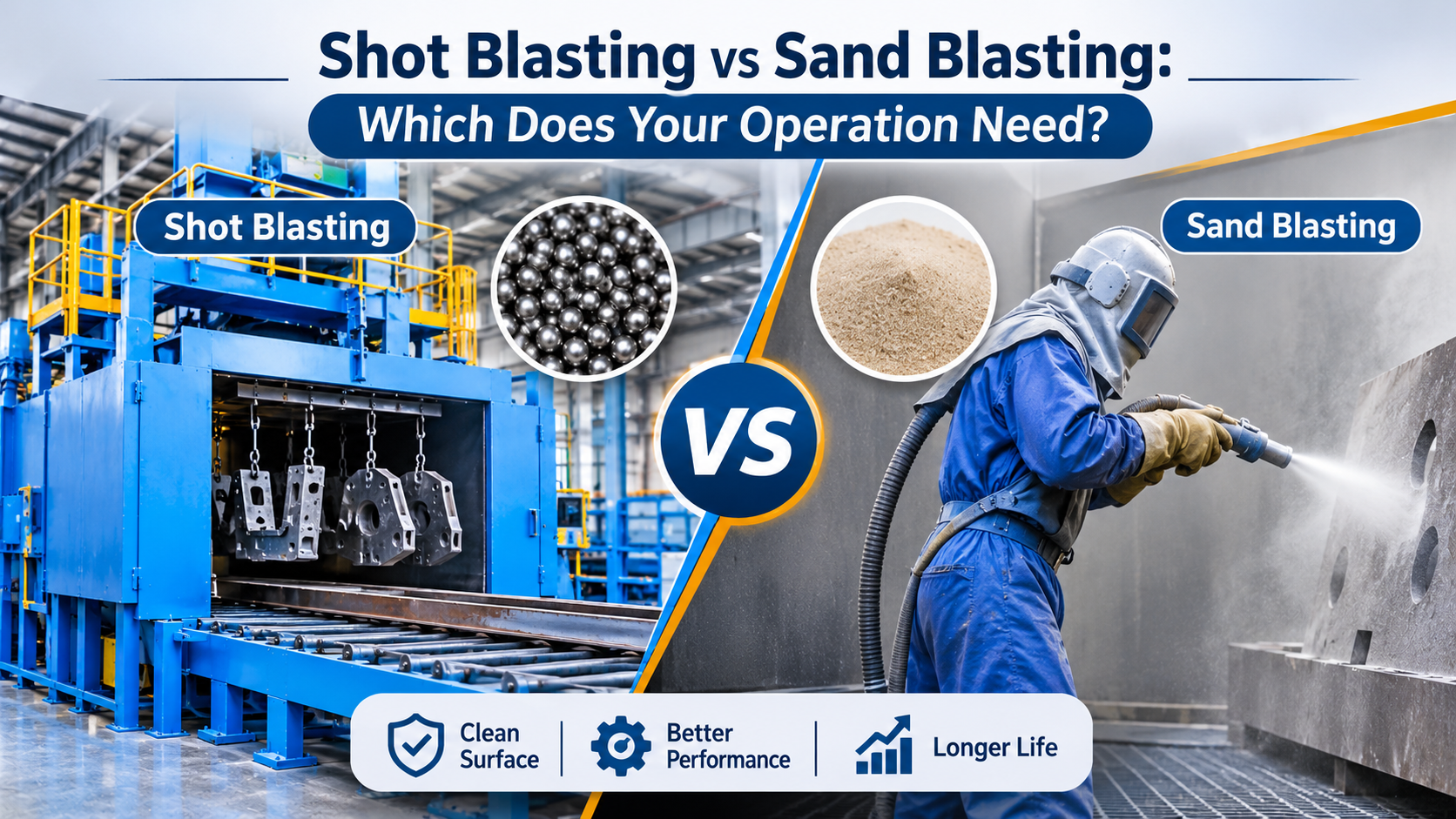
Selecting an abrasive surface treatment method is an important decision for manufacturers. The process must match the component, production environment, surface specification, and finishing requirements.
Shot blasting and sand blasting are widely recognised options, but they are not interchangeable in every industrial situation. Their equipment design, abrasive delivery, operating flexibility, and production suitability can lead to different results.
This guide explains the practical differences between shot blasting vs sand blasting and the factors manufacturers should assess before selecting a system.
Understanding the Two Blasting Approaches
The most useful way to distinguish these processes is to examine how abrasive energy reaches the workpiece.
Wheel-Driven Abrasive Treatment
In conventional airless shot blasting, a motor-driven wheel accelerates abrasive particles and projects them onto the component. The machine controls abrasive delivery through its wheel arrangement and operating settings.
This approach is commonly considered for production environments where components can be processed using a defined loading and handling system.
Compressed-Air Abrasive Treatment
Sand blasting traditionally uses compressed air to carry abrasive through a hose and nozzle. The operator or automated nozzle arrangement directs the stream towards the required surface.
Despite the traditional name, the abrasive does not have to be ordinary sand. Depending on the equipment and application, materials such as garnet, aluminium oxide, and glass beads may be used.
Shot Blasting vs Sand Blasting: How the Equipment Differs
The difference becomes clearer when the equipment is compared from an operational perspective.
Equipment factor | Shot blasting | Sand blasting |
Abrasive delivery | Rotating blast wheel | Compressed-air nozzle |
Treatment control | Wheel position, abrasive flow and exposure | Nozzle direction, air pressure and media flow |
Component movement | Often uses a fixed machine handling arrangement | Can be manual, portable or automated |
Working area | Commonly enclosed within a machine | Cabinets, blast rooms or controlled work areas |
Typical production approach | Repetitive component processing | Flexible or targeted surface treatment |
Recovery arrangement | Often integrated into the machine | Depends on system design |
The actual performance of either process depends on machine configuration, abrasive characteristics, component geometry, and operating conditions.
How Does Grit Blasting Fit into the Comparison?
Grit blasting describes abrasive treatment using angular particles, rather than identifying one specific machine design.
Steel grit is commonly used in wheel-driven systems, while suitable non-metallic abrasives can be used in compressed-air equipment. The choice of abrasive influences the surface profile, cleaning action, and suitability for the material being treated.
For this reason, grit blasting and sand blasting should not automatically be treated as separate machine technologies. The abrasive type and delivery method need to be considered independently.
Which Method Fits Different Production Conditions?
The right process depends on how the component moves through manufacturing and what the surface must achieve.
Repetitive Component Production
For manufacturers processing similar parts in regular batches, a wheel-blast system can provide a controlled treatment arrangement. The machine can be selected around the component dimensions, loading method, and production sequence.
Large or Fixed Structures
Large fabricated assemblies may be difficult to load into conventional blasting machines. A suitable blast room or compressed-air blasting arrangement can provide access to surfaces that cannot easily be handled through a standard conveyor or hanger system.
Components with Restricted Access
Parts with recesses, corners, and complex geometry require careful assessment. Abrasive access, part orientation, and shadow areas can affect treatment coverage. A trial on representative components can help establish whether the proposed system is suitable.
Maintenance and On-Site Work
Where components cannot be transported to a fixed production machine, portable compressed-air equipment may offer greater flexibility. The work area must still provide appropriate containment, dust control, and operator protection.
How Does Abrasive Selection Affect the Final Surface?
The abrasive is not simply a consumable. It is an important part of the treatment specification.
Media | Typical characteristics |
Steel shot | Rounded particles used for cleaning and selected peening applications |
Steel grit | Angular particles used for cleaning and producing a surface profile |
Garnet | Non-metallic abrasive used in suitable blasting applications |
Aluminium oxide | Hard abrasive used for selected surface preparation requirements |
Glass beads | Used where a comparatively smoother treatment is required |
Plastic media | Used for selected applications involving more delicate surfaces |
The correct choice depends on the substrate, coating requirements, required surface profile, equipment compatibility, and media handling arrangements.
Ordinary crystalline silica sand should not be assumed safe for industrial blasting. Respirable silica exposure can cause serious lung disease. Suitable alternative media, effective extraction, containment, and appropriate respiratory protection are essential considerations.
What Should Manufacturers Evaluate Before Choosing?
A process should be selected against measurable production requirements rather than its name alone.
1. Required surface standard:
Identify the specified cleanliness level and surface profile for the next manufacturing or coating stage.
2. Component geometry:
Review dimensions, weight, openings, recesses, and areas that may be difficult to reach.
3. Production arrangement:
Determine whether the work involves regular batches, continuous processing, individual components, or on-site treatment.
4. Abrasive management:
Assess media consumption, recovery, separation, storage, and replacement requirements.
5. Available utilities:
Consider electrical power, compressed-air capacity, ventilation, and space for equipment installation.
6. Workplace conditions:
Evaluate dust extraction, noise, containment, operator access, and applicable safety requirements.
7. Trial results:
Where possible, test representative parts and inspect the achieved surface before finalising the equipment specification.
A practical evaluation helps prevent selecting a machine that meets the initial requirement but does not fit the wider production operation.
Common Misconceptions About Abrasive Blasting
A few assumptions can lead to incorrect equipment selection:
Shot blasting always means steel shot: Steel grit is also commonly used in wheel-blast systems.
Sand blasting must use sand: Modern compressed-air abrasive blasting can use several alternative media.
Higher impact always gives better cleaning: Excessive impact can damage or distort unsuitable components.
One machine suits every component: Part size, shape, material, and production method influence equipment selection.
Both processes produce identical results: Surface condition depends on the abrasive, equipment, settings, and treatment specification.
Understanding these differences makes the selection process more reliable.
MEC SHOT Solutions for Industrial Abrasive Blasting
MEC SHOT Blasting Equipments Pvt. Ltd. manufactures equipment for industrial surface preparation and finishing applications.
Its published range includes airless wheel shot blasting machines, air-operated blasting equipment, shot peening systems, blast rooms, vacuum blasting equipment, and industrial dust collectors.
The equipment range supports different component-handling and treatment requirements, including:
Hanger-type machines for suitable suspended components
Tumblast machines for suitable batch-processing applications
Roller conveyor systems for steel sections and structural components
Special-purpose blasting equipment for defined applications
Blast room solutions for larger structures
MEC SHOT also provides a Technology Centre for application evaluation and sample processing.
Final Decision: Which Blasting Process Should You Choose?
Shot blasting is generally worth evaluating when the operation involves repeatable component processing through a suitably configured wheel-blast machine.
Compressed-air sand blasting is often more practical when the work requires flexible nozzle access, portable equipment, or treatment of structures that cannot be moved through a fixed machine.
Neither process is universally superior. The correct choice depends on the required surface condition, component design, production arrangement, abrasive selection, and workplace controls.
A representative component trial and a clear process specification provide a stronger basis for investment than choosing equipment by name alone.
Frequently Asked Questions
1. Are shot blasting and sand blasting the same process?
No. Conventional shot blasting uses a rotating wheel to accelerate abrasive, while traditional sand blasting uses compressed air and a nozzle. Both are forms of abrasive surface treatment.
2. What is the difference between grit blasting and shot blasting?
Grit blasting refers to the use of angular abrasive particles. Shot blasting commonly describes a wheel-driven delivery method. Steel grit can be used in a shot blasting machine.
3. Can sand blasting equipment use media other than sand?
Yes. Depending on the system, suitable abrasives include garnet, aluminium oxide, and glass beads. Media selection must match the workpiece and required finish.
4. Which process is more suitable for large steel structures?
Large structures may be treated in blast rooms or through suitable compressed-air blasting arrangements. The decision depends on dimensions, accessibility, handling, and production conditions.
5. What is a shoot blasting machine?
“Shoot blasting machine” is sometimes used as a spelling variation of “shot blasting machine.” In industrial equipment searches, the intended meaning is generally a machine that propels abrasive particles for surface treatment.
6. Is media blasting different from shot blasting?
Media blasting is a broader term for processes that use propelled abrasive materials to treat a surface. Shot blasting is one type of media blasting, typically using a rotating blast wheel.
7. How can manufacturers compare the operating costs?
Compare electricity or compressed-air consumption, abrasive usage, recovery efficiency, dust collection, maintenance, replacement parts, and labour requirements. The total operating cost matters more than the initial machine price.
8. How can I confirm which blasting method is suitable?
Define the required surface specification, assess the component and production conditions, and conduct a trial using representative parts where possible. Equipment selection should be based on the trial results and actual operating requirements.